


If someone spoke to you in a language you didn’t understand, everyday conversations would quickly become confusing. You might misunderstand their intentions, respond inappropriately, or miss important messages altogether.
The same can happen when we live with cats.
Our cats are communicating with us every day—not through words, but through their body language, facial expressions, posture, movement, and even the way they use their whiskers. The challenge isn’t that cats are mysterious. It’s that many of us were never taught how to understand what they’re saying.
At Pawetiquette, we believe that learning to “speak cat” is one of the most valuable skills any cat caregiver can develop. It doesn’t require special talent, only observation, patience, and a willingness to learn.
Why Body Language Matters
Cats are experts at subtle communication.
Unlike people, they rarely rely on dramatic gestures to express themselves. Small changes in their posture or facial expression can tell us whether they’re relaxed, curious, uncertain, playful, frightened, or ready to be left alone.
When we recognize these signals early, we can respond appropriately before stress escalates into unwanted behaviors such as scratching, hiding, hissing, or biting.
In many cases, understanding body language helps us prevent problems instead of simply reacting to them.
The Tail: More Than a Mood Indicator
Many people know that a cat’s tail communicates emotion, but it’s only one part of a much larger conversation.
Here are a few common examples:
- Tail held upright: Often a friendly greeting and a sign of confidence.
- Tail wrapped around the body: Your cat may be feeling cautious, uncertain, or simply resting.
- Puffed-up tail: Usually indicates fear or an attempt to appear larger when feeling threatened.
- Tail flicking or lashing rapidly: Often a sign of frustration, overstimulation, or irritation rather than happiness.
Remember that the tail should always be interpreted alongside the rest of the body.
The Ears Often Speak First
A cat’s ears constantly rotate to gather information about the world around them.
Their position can offer valuable clues about how your cat is feeling.
- Facing forward: Interested, relaxed, or curious.
- Turning sideways (“airplane ears”): Becoming uncomfortable or uncertain.
- Flattened backward: Fear, defensiveness, or significant stress.
If you notice your cat’s ears changing position during petting or play, it’s often their polite way of asking for a change before they resort to stronger signals.
The Eyes Reveal More Than You Think
Cats communicate through their eyes in ways many people overlook.
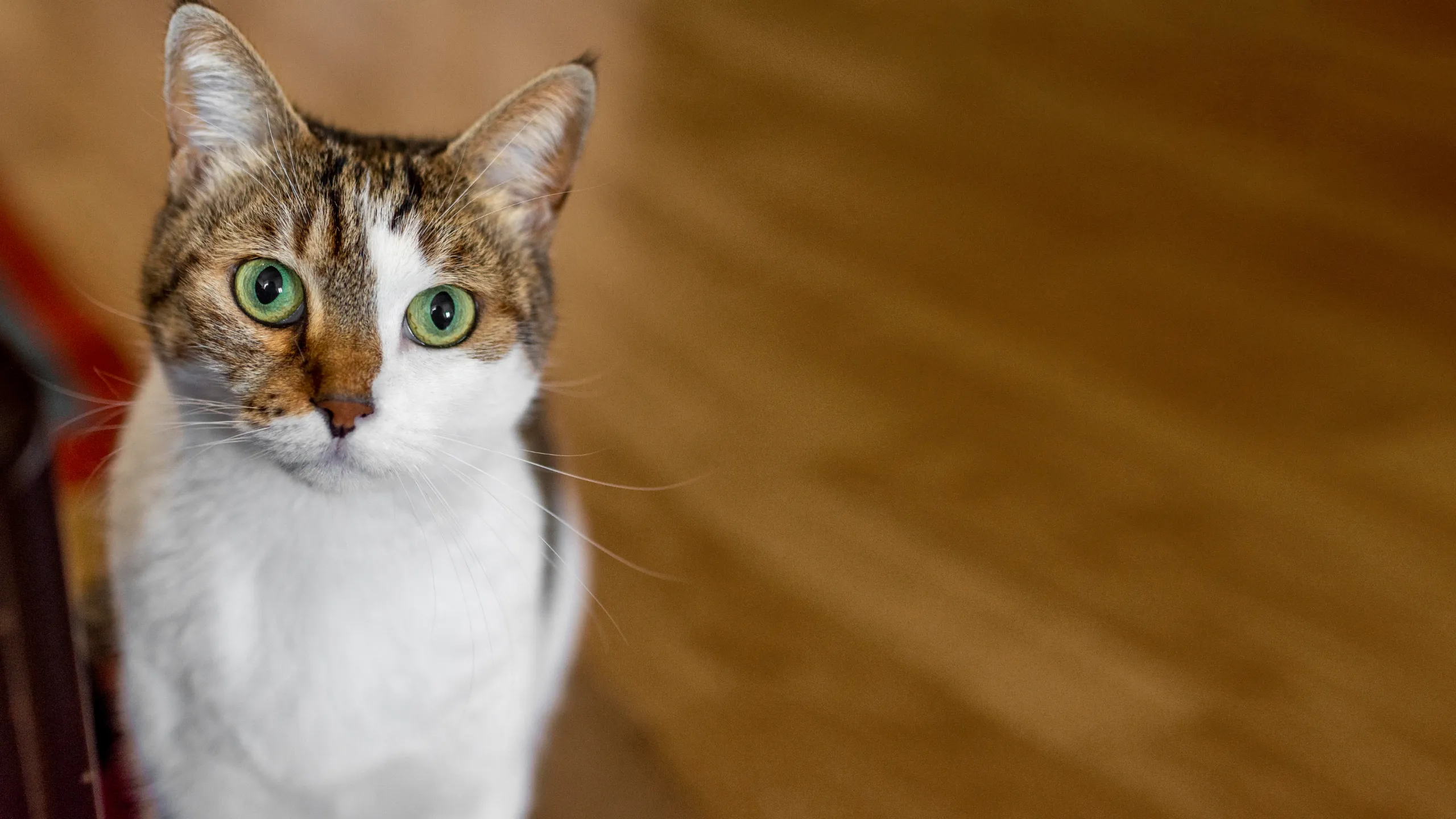
A relaxed cat may blink slowly while looking at someone they trust. This isn’t a magical gesture, but it is commonly associated with comfort and positive social interaction.
Wide, dilated pupils, however, can have many meanings. They may indicate excitement during play, heightened arousal, fear, or surprise. Bright lighting, age, and health can also affect pupil size.
Similarly, narrowed pupils don’t automatically signal aggression. They may simply reflect bright light or focused attention.
The eyes always need context.
Whiskers Are Active Communication Tools
Whiskers aren’t just adorable—they’re highly sensitive sensory organs that help cats gather information about their surroundings.
They can also provide useful behavioral clues.
- Relaxed whiskers: Usually sit naturally to the sides.
- Whiskers pushed forward: Your cat may be investigating something, hunting, or showing intense interest.
- Whiskers pulled back against the face: Can indicate uncertainty, fear, or discomfort.
Because whiskers work together with other body signals, they should never be interpreted in isolation.
Posture Tells the Bigger Story
Rather than focusing on one body part, try observing your cat as a whole.
Ask yourself:
- Are they moving confidently?
- Is their body loose or tense?
- Are they approaching or creating distance?
- Are they choosing to interact or asking for space?
A relaxed body usually signals comfort.
A crouched body, tense muscles, or attempts to make themselves appear smaller may suggest that your cat doesn’t feel completely safe.
On the other hand, an arched back accompanied by puffed fur often indicates that your cat is trying to appear larger in response to fear.
Context Is Everything
One of the biggest mistakes we can make is assuming that a single body signal always has the same meaning.
Imagine someone smiling while receiving wonderful news. Now imagine someone smiling nervously during a stressful interview.
The same expression can reflect different emotions depending on the situation.
Cats are no different.
A rapidly moving tail during play doesn’t necessarily mean the same thing as a rapidly moving tail during petting.
Dilated pupils during a toy chase don’t carry the same meaning as dilated pupils when confronted by a frightening noise.
Body language should always be understood within the context of what’s happening around your cat.
Listening Before Reacting
Sometimes we unintentionally ignore the quieter signals our cats give us.
Perhaps we continue petting after they’ve turned their ears sideways.
Maybe we pick them up when they’ve already started leaning away.
Or we assume they enjoy an interaction simply because they haven’t walked away.
Cats often communicate politely long before they feel the need to hiss, swat, or bite.
The more we notice those early signals, the more we can respect their boundaries and strengthen the trust between us.
Becoming Fluent Takes Time
No one learns a new language overnight.
Learning your cat’s body language works the same way.
Spend a few minutes each day simply watching your cat without interrupting them.
Notice how they look during play, while resting, before meals, when greeting you, or when meeting someone new.
Over time, you’ll begin recognizing patterns that are unique to your own cat.
That’s one of the beautiful things about living with cats: while they share many common forms of communication, every individual has their own personality and preferences.
The Pawetiquette Perspective
Understanding body language isn’t about memorizing a checklist.
It’s about changing the way we see our cats.
Instead of asking, “How do I make my cat do what I want?” we begin asking, “What is my cat trying to tell me?”
That simple shift transforms the relationship.
When we choose curiosity over assumption, observation over judgment, and understanding over frustration, we become better caregivers—and our cats are more likely to feel safe, understood, and respected.
After all, living with cats isn’t just about sharing the same home.
It’s about learning each other’s language.
Want to better understand your own cat?
Every cat communicates a little differently. While general body language can teach us a great deal, your cat’s history, personality, health, and environment all influence how they express themselves.
If you’re struggling to interpret your cat’s behavior or want personalized guidance, Pawetiquette’s behavior consultations are designed to help you better understand your cat’s unique communication style and strengthen the bond you share.
The better we understand our cats, the better we can care for them—and that’s what Pawetiquette is all about.
